Civil Rights Teaching

test widget

  • Home
  • News

Mississippi Teacher Fellows Host Workshops Across the State

September 27, 2015 by Julian Hipkins

Raymond Brookter
Raymond Brookter

“I want to bring these lessons on teaching about the Civil Rights Movement to teachers in my school district.”

Raymond Brookter’s sentiment was echoed by all the participants in our summer institute for Mississippi teacher fellows.

On top of their full course load, these teachers rolled up their sleeves and made that vision a reality.

In early September, teacher fellows in Kosciusko, Laurel, and Hattiesburg organized full-day workshops for teachers and/or students in their respective school districts. Teachers in Harrison, Hinds, Marion, Benton, and Sunflower counties hosted sessions at the end of the month.

At the launch of the teacher fellowship, SNCC veteran Hollis Watkins urged the project partners to “make sure that we spread the work out so that we have a lot of hands on the plow.” The teachers (who had the honor of meeting Watkins this summer) took that advice to heart. Rather than simply bringing lessons on the Civil Rights Movement to their own classrooms, they are introducing the Mississippi history and interactive pedagogy to their peers.

Teaching for Change is assisting the teacher fellows with planning and implementation of this district based outreach. Mississippi teacher fellowship project director Julian Hipkins III traveled to each of the districts to conduct workshops. Here are highlights from the sessions.

IMG_1215
Hipkins with teachers from Kosciusko High School.

Teacher fellows Jessica Dickens and Glendolyn Crowell made arrangements for a full day of professional development for the Kosciusko social studies department. They invited Hipkins to facilitate interactive lessons on Mississippi history and opportunities for reflection. The lessons included a gallery walk on the history of race and education in Mississippi and a meet and greet activity about the southern freedom movement. The response was enthusiastic:

Fantastic, energizing, refreshing…..great strategies and tactics to use in the classroom.

The day was a perfect balance between content, pedagogy, self reflection, and conversation. At no point was I bored or ready to leave like many professional development sessions.

This was a really great seminar. Probably the best I’ve been to in 22 years of teaching.

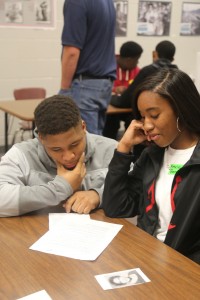
Jones County teacher fellow Raymond Brookter arranged for a day of lessons to expose students to the foot soldiers of the Civil Rights Movement in the library of Laurel High School. Using the meet and greet activity about the southern freedom movement, students were each assigned the role of a Mississippi activist. Individuals such as Fannie Lou Hamer, Ella Baker, and Medgar Evers were brought to life as students donned name tags with images of their historical figure and met others involved in the freedom struggle. Students also had an opportunity to take part in the gallery walk on the history of race and education in Mississippi. This led them to share stories and insights about their own schooling. “Have the textbooks really changed?” asked one student.

Throughout the day, approximately 200 students participated in the lessons. “Thank you for sharing this history with us,” one student said. Another added, “I have never heard of these people before. We don’t learn, see, or hear about this part of Black history.”

In Hattiesburg and Jackson, high school students engaged in a gallery walk about the history of education in Mississippi. One student wrote “#BlackEducationMatters” next to an image about the unequal distribution of funds in the state during the early 20th century.
IMG_6027 2
IMG_3526
At Indianola High School, students explored the roots of contemporary wealth inequality with respect to race. Hipkins engaged them in a lesson on the 1921 Tulsa Race Riot when deputized whites killed more than 300 African Americans and destroyed the thriving community known as Black Wall Street.

In a human geography class at Gulfport Central Middle School, Hipkins made a world history connection to the Civil Rights Movement with an interactive lesson on the legacy of colonialism in the Congo. Reflecting on the current conflict and who is responsible, one student asked, “What is our responsibility as consumers?”

IMG_3603

Journalism students at Murrah High School in Jackson examined historic Mississippi cases related to race and the media. They were shocked to see that the role of the media had been to suppress, rather than share, news about civil rights movement activism.

To bring these issues to an African American Literature class, Hipkins had the students read children’s picture books about the Civil Rights Movement. The students (in Benton County) were asked to critique the books based on content, illustrations, and overall impact. This led to a rich discussion about the appropriate age for young people to learn about racism.

IMG_1190 FannieLouHamer9780763665319

In most of the school districts, administrators as well as teachers observed the classes and shared their enthusiasm. In Harrison County, Superintendent Glen East left a note for teacher fellow Cristina Tosto:

Ms. Tosto, What you are doing today is tremendously important in our Democratic society. You are providing a great compass for your students. Glen East

IMG_3553 IMG_3550

In Attala, Harrison, Hinds, Jones, and Marion counties, the teacher fellows also scheduled professional development sessions to introduce their colleagues to this content and pedagogy.

IMG_3537 IMG_6056

The fellowship program is still open for Mississippi teachers who would like to apply. This work is made possible by grants from the Kellogg Foundation and the Open Society Foundations and guidance from our project partners.

There are more photos from the sessions in first three school districts here and the next five districts here.

Filed Under: Mississippi, News Tagged With: Hattiesburg, Kosciusko, Larel, mississippi

Building a Civil Rights Teaching Community in Mississippi

August 6, 2015 by Julian Hipkins

19925374576_24386dc743_o
Fellows with Civil Rights Veterans. From L to R: MacArthur Cotton, Flonzie Brown Wright, Ineva May-Pittman, Hollis Watkins.

In July 2015, eleven middle and high school teachers from the across the state of Mississippi met to share resources and stories about how to bring a deeper understanding of the rich history of civil rights and labor movements in Mississippi to their students. During the course of the week they created a strong bond based on their shared commitment to introduce students to the bottom-up and often hidden history of the state. As Kosciusko (northeast of Jackson) teacher Jessica Dickens said on the first day, “I’m in heaven to be among so many like-minded educators.”

Modeled on the philosophy of the Mississippi Freedom Schools, the activities throughout the week were participatory with a focus on examining not just history, but also issues of race and equity in schools today. They included writing stories and poetry, role plays, guest speakers, field trips, lesson planning, uncovering local history, and more.

The institute was designed to help participants deepen their understanding of Mississippi civil rights and labor movement history, explore interactive pedagogy, develop a collaborative teacher community, and plan for statewide expansion.

It was part of the Mississippi Civil Rights Movement and Labor History fellowship organized by Teaching for Change with funding from the W.K. Kellogg Foundation and the Open Society Foundations.

Here are some highlights from the week.

Mississippi Civil Rights Movement History

Unsung hero Wiley Mae Foard. Her story was researched and posted on the Historypin online map by teacher Glendolyn Crowell.

The exploration of Mississippi history began with local untold stories in the teachers’ home communities. Before coming to the institute, fellows were asked to research an unsung s/hero from their town. They placed the people and stories they found on the online Historypin map page dedicated to uncovering Mississippi’s hidden history.

A few of the teachers had to dig deep to find their unsung hero. When they began, they were told that there was no activism in their community. Motivated by the assignment and the knowledge that people are active everywhere, they went to the Mississippi State Sovereignty Commission files. (This is the state agency that spied on and documented the actions of more than 87,000 civil rights volunteers.) Sure enough, names surfaced. Webster County native Glendolyn Crowell recognized one name on the list–her own elementary school principal. With that lead, she reached out to the Mayor and her Facebook friends to learn more. On the final day of the institute, the unsung heroes sprung to life in a lesson prepared with the fellows’ research. Each person was given a bio of one of the Mississippi unsung heroes and invited to interview their peers (all in the role of an unsung hero) with a set of guiding questions. (The format for the lesson was based on Unsung Heroes by Bill Bigelow.)

The fellows engaged in role plays related to some of the stories in Mississippi history that are seldom included in mainstream history textbooks. For example, in a lesson on the Mississippi Freedom Democratic Party (MFDP), the fellows took on the on the role of Mississippians at the 1964 Democratic National Convention in Atlantic City. After interviewing each other and listening to the memorable testimony by Mrs. Fannie Lou Hamer to the Credentials Committee, they had to decide whether or not to accept the offer by LBJ to have two delegate at large seats. Most soundly rejected it, saying that two seats did not even qualify as a compromise.

Dr. Roy DeBerry and Glendolyn Crowell in the MFDP role play.
Dr. Roy DeBerry and Glendolyn Crowell interview each other during the Mississippi Freedom Democratic Party (MFDP) lesson.

One of the special guests for the day, project partner Roy DeBerry, engaged in the role play as himself. At the age of 16, DeBerry was on the boardwalk in Atlantic City with the MFDP.

After the lesson, DeBerry responded to additional questions and shared favorite memories, such as Mrs. Hamer stepping out of the Convention Center to lead the group in song.

The lessons introduced in the institute were selected based on issues surfaced by the fellows. With the Confederate flag in the daily news, one request was for lessons to explore the impact of racism on white allegiances in history—particularly working class whites. The lesson on the Southern Tenant Farmers Union was ideal. It introduced a seldom taught story of Black and white sharecroppers uniting during the Great Depression. Role playing conversations between union organizers and sharecroppers, participants could see the benefits and risks of coming together.

reeves-f610c40457f259110600b974ae67c43aa313beb8-s300-c85
Judge Carlton Reeves

As another rich source of history, guest speakers and field trips were featured throughout the week. Judge Carlton Reeves described his own education and political awakening, Dr. Daphne Chamberlain shared stories and photos about the role of youth in the Mississippi Civil Rights Movement, Dr. Roy DeBerry introduced classroom friendly resources on the Hill Country Project website, and Albert Sykes provided a detailed overview and analysis of the politics of education in Mississippi today.

During a full day in Jackson, fellows gathered in historic Woodworth Chapel at Tougaloo College to hear from veterans Ineva May-Pittman, Flonzie Brown Wright, Hollis Watkins, and MacArthur Cotton. The moving panel was organized by Cynthia Palmer, director of the Veterans of the Mississippi Civil Rights Movement, Inc. Jackson fellow Lynne Schneider stated,

These are more than just lessons or activities I can pull from at some point in time, but rather living people I can connect with and draw from.

Fellows also visited the Mississippi Department of Archives and History, the International Museum of Muslim Cultures, and the Medgar Evers Home Museum. At the Evers home, Ms. Minnie Watson gave an animated and detailed history of Evers’ life and legacy.

Key films were introduced, included Standing on My Sisters Shoulders, Eyes on the Prize, Freedom Song, and Come Hell or High Water: The Battle for Turkey Creek. A resource table, full of books and more films on Mississippi history, was available to fellows throughout the week.

Interactive Pedagogy

A wide range of strategies were used throughout the week so that teachers could “try them on” and determine which ones could be adapted to their own classrooms. These included:

19879607116_d85b612a62_o
Lynne Schneider adds her comments to the gallery walk.
  • A gallery walk invited fellows to explore the history of education in Mississippi, leading up to their role today. The text and images of the gallery walk began with pre-Mississippi in the ancient city of Timbuktu, moving through Reconstruction to present day issues such as Initiative 42. Participants wrote their thoughts on chart paper next to an image or text and were encouraged to comment on what others wrote as well.
  • To facilitate discussion of articles and primary documents, protocols such as Save the Last Word for ME and Issaquoh were used. The protocols, from the National School Reform Faculty/Harmony Education Center, were effective in allowing everyone a chance to speak and be heard. One of the articles discussed was by SNCC veteran Charles Cobb Jr. on the relationship between nonviolence and self-defense.
  • Participants stepped into history with role plays, such as the lesson on the Mississippi Freedom Democratic Party. Each role play had dozens of characters, immediately shattering the narrative of a handful of heroes making history. The role plays also show history as a set of choices or dilemmas, rather than an inevitable sequence of events.
  • Community building activities were used every day so that the fellows could get to know each other. These included people bingo, concentric circles, and writing about “in whose shoes I’m walking.”
19925373976_df4f7e88f1_o
Diana Dombrowski, Falana McDaniel, and Sarah Blanc.

Since many teacher will engage students in uncovering and documenting their local history, Sarah Blanc and Diana Dombrowski of the Samuel Proctor Oral History Program provided a workshop on oral history collection. The session included oral history process, technology, and techniques and the offer for follow-up guidance. Each fellow received a packet of oral history resources, including a copy of the publication, “I Never Will Forget”: Memories from Mississippi Freedom Summer.

Fellows learned about National History Day as an opportunity for students to document and share local history. They saw a film created by students in McComb with local history interviews for National History Day. Their instructor, Oral History Association award winner, Falana McDaniel talked about the process and benefits of engaging middle and high schools students in local history research, including oral history collection.

Finally, fellows took time to design their own lessons or map out their semester based on the institute ideas generated during the institute.

Fellow Lynne Schneider commented,

What I am most pleased with is so many ways to create a student-centered classroom and a new focus on youth activism. I can’t wait to work with students on movements they are hungry to be a part of.

Collaborative Community

When teachers signed up for the fellowship, many spoke of the isolation they felt in their respective school districts and the desire to be part of a learning community. Therefore, a focus for the week was finding ways to deepen and sustain a nurturing, collaborative community among the participants.

It began with activities to help the fellows get to know each other, including People Bingo and Big Shoes to Fill. Fellows wrote a story about a time that they stood up against injustice or a person in whose shoes they are walking. As each person read their story, the life stories began to walk a path together. Here is the “big shoes to fill” story from Hattiesburg fellow Raymond Brookter:

19719166479_eb3cd85a72_o
Raymond Brookter

Although these are big shoes to fill, I am following in the footsteps of giants. I am following in the footsteps of my mother, Mary Lee whose early recitation about how her father was returned to their home split down the face and neck for what was supposed to be an accident at the woodmill, affected me greatly. I follow in the steady but sure footsteps of Abraham, my father who had to lift a Model A Ford from his brother’s chest after three jealous white men pushed it upon him while he repaired a tire. I follow in the footsteps of these dead “too young” and “too soon” as the scourge of drug addiction and alcoholism tore about families, communities, and futures. It is upon Ricky, Bean, Dot, Karl, Monk, Dennis, Mark, Joe and Mike that every step I take to tutor one more student or write one more recommendation letter is not in vain. It is the footsteps of Aunt Genie, Aunt Mamie, and Aunt Ida that hold my pace as I walk through my teaching of youth, and it is the small footprints of a little boy that didn’t talk like a Negro child to walk like a Black man.

In preparation for the final day of the institute, fellows wrote poems using a mirror or “write that I” refrain about the unsung hero from their community. Fellows were moved to tears as the tributes to the unsung Mississippi heroes filled the room. Gulfport fellow Cristina Tosto wrote about Dr. Gilbert Mason:

Dr. Gilbert Mason
Dr. Gilbert Mason

Write that I,
Born in the slums of Jackson
I too, had a dream.
Write that I,
Experienced the degradation of Jim Crow
And was strengthened by
My Black community.
Write that I,
Doctor and activist,
Led my people to the beach.
Not once but four times.
I cared for my people
As blood dripped from my own head.
I saw the bloodshed
And felt the cold metal on my wrists.
Write that I,
Together with Medgar Evers, Dr. Felix Dunn,
And hundreds of other Mississippians,
Desegregated the beaches and the schools
And registered voters
Write that I,
Longed for equality and respect,
Wanted to heal
Not just my people
But the hate.
Write that I
Am Dr. Gilbert Mason.

By the end of the week, teachers testified to the strength of the collaboration. Tosto said,

The fact that I know that my fellows are all over Mississippi teaching civil rights and labor history through higher-level, interactive lessons is a great comfort to me. To know that I won’t be alone in attempting to change the state of education in Mississippi and that I have a group to lean on and help me I think is the most valuable thing I have received from the institute.

Statewide Expansion

On the last day, the fellows affirmed that not only do they want to deepen the work in their own classrooms, but they also want the effort to expand. They set to work brainstorming outreach strategies, key allies, and a name for the initiative. Some drafted designs for posters and t-shirts. The group will reconvene in October to finalize those plans. In the meantime, the fellows are coordinating professional development in their respective school districts with the project director Julian Hipkins III.

[ezcol_1half]

19717820790_20dfc0b95c_o
Lynne Schneider and Marsha McNail discuss classroom strategies.

[/ezcol_1half] [ezcol_1half_end]

Alma McDonald and Maryam Rashid in the roles of unsung Mississippi heroes.

[/ezcol_1half_end]

Throughout the week, project partners visited the institute, creating one to one connections with fellows and their respective institutions—and contributing to ideas about statewide growth. Partners visitors included Jackie Byrd Martin (William Winter Institute), Cynthia Palmer (Veterans of Mississippi), Okolo Rashid (International Museum of Muslim Cultures), Von Gordon (William Winter Institute), and Roy DeBerry (Hill Country Project).

[ezcol_1half]

Teacher fellows Jessica Dickens and Philip Mohr with partner Von Martin (center).
Teacher fellows Jessica Dickens and Philip Mohr with partner Von Gordon (center).

[/ezcol_1half] [ezcol_1half_end]

Partners Jackie Byrd Martin, Von Gordon, and co-facilitator Jenice View.

[/ezcol_1half_end]

A powerful teacher community was launched which can directly impact classrooms and engage more educators statewide. Here are some closing reflections:

The impact of the institute was tremendous for me. I was left with an excited feeling in which I could not wait to return to the classroom. — Marsha McNail

I was struck by the emphasis on untold or “undertold” stories of civil rights activism. At the end of the Summer Institute, I was able to see how closely Mississippi’s local resources (people, events, landmarks, stories) could be used to engender new activism among young people today. Even more than the AP Institute and my Master’s degree courses, this was the best (most effective, efficient, and inspiring) professional development opportunity that I have had in five years of teaching. — Philip Mohr


Filed Under: Mississippi, News

Selma in Kosciusko

April 1, 2015 by Deborah Menkart


“Women can do just as much as men can when it comes to leadership.” This is just one of the comments made by students in Jessica Dickens’ class in Kosciusko, Mississippi.

Dickens, a teacher the Kosciusko School District and Mississippi Civil Rights movement and Labor History teacher fellow, recently introduced the lesson, Stepping into Selma: Voting Rights History and Legacy Today, to her 10th grade class. Dickens stated:

Jessica DickensThe best part of teaching this activity was to see the students buy in to it so much. It was more than just a brief overview of a time in history. With both the film (Selma: The Bridge to the Ballot) and the role play, students were able to step into the shoes of the characters in Selma. With the movement in Selma being started mainly by teenagers their own age, it was made more relevant to them.
Also, understanding how the government failed to protect the citizens of Selma, we were also able to make connections to events today, such as Ferguson.

Her students shared reflections too.

I enjoyed this lesson because I got a chance to be someone who I have never heard of before. Amelia Boynton was one of the women who led the Civil Rights Movement, specifically in Selma. During the film, I actually got to see some of the brutal beatings that happened in the 60s. In the film, it showed how my character, Amelia Boynton, was shoved by police officers. Some of the things on the film I already knew about, but I also learned about a lot of lesser known people other than Dr. King and Malcolm X. My character in the activity showed me that women can do just as much as men can when it comes to leadership. —Feria M.

I enjoyed this role play activity because I learned details about African Americans who fought and marched for equality and the right to vote. I played Malcolm X in the activity and learned there were many faces to the movement in Selma. To learn the hardships that black people went through inspires me to do the best that I can with the rights I have now. —DeVontaye S.

I enjoyed playing the role of John Lewis. I learned how bad Bloody Sunday really was. I also learned that John Lewis got struck in the head with a billy club and had to be hospitalized. I think it is impressive that he was such a huge part in the movement in Selma and now serves as a U.S. Congressman. The events of the Selma March really opened my eyes to how unjust our country has been in the past. —Blake S.

Filed Under: Mississippi, News

Local History Awards at Mississippi History Day 2015

March 23, 2015 by Julian Hipkins

crt-post-logosOn Mar. 22, 2015, the annual Local Mississippi History Awards were given at the Mississippi History Day competition at the University of Southern Mississippi.

The goal of the award is to deepen student appreciation of and exploration of the untold stories and role of “everyday people” in local Mississippi history, using the National History Day competition as an incentive and a focus for student projects. (See 2013 and 2014 awardees.)

Thanks to a grant from the W.K. Kellogg Foundation to Teaching for Change, five Local History Awards were given for $100 for each student or student team.

2015 Award Winners

Freedom Riders Website (Junior Group Website)

Asia Lamkin, Lauren Johns, Jaden Martin. Denman JH and McComb HS.
Asia Lamkin (not in photo), Lauren Johns, Jaden Martin. Denman JH and McComb HS.

Colvard, McCarthy, and the 1963 Mississippi State Basketball Team:
Game Changers in the Fight Against Segregation (Senior Paper)

Jonathan Franz with Julian Hipkins III


All Aboard: A Brotherhood Leadership for a National Legacy (Senior Group Documentary)

Railroad project winners
Damion Jordan, Courtney Coney, Corina Cepeda (not in photo) with Julian Hipkins III (McComb High School)

The Mississippi Man (Senior Group Performance)

Mississippi Man
K.J. Peebles, Keanna Rush, Andria Carter, Traveon Wingo, Hannah Bennett, Neshoba Youth Coalition

Elvis Presley (Junior Group Documentary)

Elvis Presley project
Jackson Rhoades, Sarah Daniels, Francesca Patawaran, Tupelo Middle School

Judges, Coordinators, and Teachers

IMG_3163
Local history award judges (L to R) Jackie Byrd Martin, Tristal Watson, Marsha McNeil, Alma McDonald, and Julian Hipkins III. (McDonald, Watson, and McNeil are Mississippi Civil Rights Movement and Labor History teacher fellows.)

IMG_3171
McComb teacher Alan Wheat will lead the Mississippi team to History Day Nationals in Maryland in June.

IMG_3165
Teacher fellow Anthony Golding brought students from Tupelo Middle School.
Dr. Allison Abra, assistant professor of history at USM and MHD co-coordinator.
Photos by Alma McDonald.

Filed Under: Mississippi Tagged With: Mississippi History Day

Marion Barry Shares Memories with High School Students

December 18, 2014 by Julian Hipkins

Marion Barry
Marion Barry, 2011.

I was born in the Delta of Mississippi in a town called Itta Bena, about 15 miles from Greenwood. About 35 miles from Greenville. About 10 or 15 miles from Indianola, where B.B. King grew up.

My mother and father were sharecroppers. That means that they bought the cotton seeds from some white man, planted the seeds, harvested the cotton, plowed the fields, and on the side we had a garden, and had pigs, hogs, and chicken. . . . I am sure that the white man sold the cotton seeds higher than what he paid for them and bought the cotton lower than he sold it for, which was exploitation.

—Marion Barry, responding to a student’s question, “What is your earliest memory?”

This was one of many questions posed by students in a one hour interview with civil rights movement activist and politician Marion Barry (March 6, 1936–Nov. 23, 2014). The interview was conducted on March 24, 2011 by students from McComb High School and the Urban School of San Francisco as part of the Telling Their Stories Oral History Archives Project. Barry served as the mayor of Washington, D.C. from 1979-1991 and then again from 1995-1999. Before serving as mayor, he was the first chairperson of the Student Nonviolent Coordinating Committee (SNCC).

CRT-Students-Interview-Barry

This interview was conducted during the Veterans of the Mississippi Civil Rights Movement 2011 Conference at Jackson State University. (Please note that QuickTime is required for viewing and it is not compatible with Chrome on some computers.) Download transcript here.

Also available on YouTube below.

This is one of many interviews available on Mississippi history on the McComb Legacies website.

Additional Resources on Marion Barry

Marion Barry bio on BlackPast.org.

Statement by Marion Barry on voting in May 1965, Civil Rights Movement Veterans website.

Filed Under: Mississippi

Charles McDew: “Why The Others Died”

October 6, 2014 by Julian Hipkins

Charles McDew

The only thing that will make our lives or our deaths meaningful is that we tell the story of why we did what we did and why the others died.

Charles McDew describes the terror of imprisonment and threats to the lives of Civil Rights Movement activists and others during the freedom struggle in a Moth Radio Hour story, “Why The Others Died” (9/30/2014).

In the conclusion to his chilling and tragic story, he notes, “It gave me to understand that it is not a struggle of black people or white people dominating black people; it is a struggle of people without power being exploited, run over, and destroyed.”

Background on Charles McDew

Charles McDew led his first demonstration in the eighth grade, to protest violations of the religious freedom of Amish students in his hometown of Massillon, Ohio.

Charles McDew 2/17/1962.

McDew’s career as an activist expanded in scope while he was a freshman at South Carolina State College in Orangeburg, SC. Inevitably involved in the newborn sit-in movement, he was elected as student leader by his fellow demonstrators.

McDew attended the founding conference of the Student Nonviolent Coordinating Committee (SNCC) at Shaw in April 1960 while a student at South Carolina State and a member of the Orangeburg Movement for Civil Improvement. He served as the second chairperson of SNCC, from 1961-1963.

1963 SNCC fundraiser at the home of actor and activist Theodore Bikel. (l-r) Ivanhoe Donaldson Chuck McDew, Lorraine Hansberry, Nina Simone, Theodore Bikel, and James Forman.  (c) LHLT private collection. Click for more info.
1963 SNCC fundraiser at the home of actor and activist Theodore Bikel. (l-r) Ivanhoe Donaldson, Chuck McDew, Lorraine Hansberry, Nina Simone, Theodore Bikel, and James Forman. (c) Lorraine Hansberry Literary Trust (LHLT) private collection. Click for more info.

McDew has been active in organizations for social and political change, working as a teacher and as a labor organizer, managing anti-poverty programs in Washington, D.C., serving as community organizer and catalyst for change in Boston and San Francisco, as well as other communities.

He has appeared on countless radio and television programs as a speaker against racism. McDew recently retired from Metropolitan State University, Minneapolis, MN, where he taught classes on the history of the civil rights movement, African-American history, and in social and cultural awareness. [Bio from SNCC 50th Anniversary website.]

mothlogoListen to and share Chuck McDew’s story here.

Filed Under: Mississippi, News

  • « Previous Page
  • 1
  • 2
  • 3
  • Next Page »
A RESOURCE GUIDE FOR CLASSROOMS AND COMMUNITIES

Putting the Movement Back into Civil Rights Teaching

Learn more

Copyright © 2026 · Minimum Pro on Genesis Framework · WordPress · Log in