Civil Rights Teaching

test widget

  • Home
  • News

Selma in Kosciusko

April 1, 2015 by Deborah Menkart


“Women can do just as much as men can when it comes to leadership.” This is just one of the comments made by students in Jessica Dickens’ class in Kosciusko, Mississippi.

Dickens, a teacher the Kosciusko School District and Mississippi Civil Rights movement and Labor History teacher fellow, recently introduced the lesson, Stepping into Selma: Voting Rights History and Legacy Today, to her 10th grade class. Dickens stated:

Jessica DickensThe best part of teaching this activity was to see the students buy in to it so much. It was more than just a brief overview of a time in history. With both the film (Selma: The Bridge to the Ballot) and the role play, students were able to step into the shoes of the characters in Selma. With the movement in Selma being started mainly by teenagers their own age, it was made more relevant to them.

Also, understanding how the government failed to protect the citizens of Selma, we were also able to make connections to events today, such as Ferguson.

Her students shared reflections too.

I enjoyed this lesson because I got a chance to be someone who I have never heard of before. Amelia Boynton was one of the women who led the Civil Rights Movement, specifically in Selma. During the film, I actually got to see some of the brutal beatings that happened in the 60s. In the film, it showed how my character, Amelia Boynton, was shoved by police officers. Some of the things on the film I already knew about, but I also learned about a lot of lesser known people other than Dr. King and Malcolm X. My character in the activity showed me that women can do just as much as men can when it comes to leadership. —Feria M.
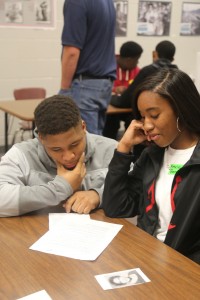
I enjoyed this role play activity because I learned details about African Americans who fought and marched for equality and the right to vote. I played Malcolm X in the activity and learned there were many faces to the movement in Selma. To learn the hardships that black people went through inspires me to do the best that I can with the rights I have now. —DeVontaye S.

I enjoyed playing the role of John Lewis. I learned how bad Bloody Sunday really was. I also learned that John Lewis got struck in the head with a billy club and had to be hospitalized. I think it is impressive that he was such a huge part in the movement in Selma and now serves as a U.S. Congressman. The events of the Selma March really opened my eyes to how unjust our country has been in the past. —Blake S.

Filed Under: Mississippi, News

Teaching About Selma

January 26, 2015 by Deborah Menkart

The release of the film Selma in this 50th anniversary year of the Selma-to-Montgomery March and the Voting Rights Act of 1965 has helped generate great interest in these pivotal stories from the Civil Rights Movement.

Schools across the country are taking students to see the film. Commemorative events will be held all year.

selma-15-points-boxToday, racial equity and voting rights are front and center in the lives of young people. There is much they can learn from stepping into the history of the Selma voting rights campaign and the larger Civil Rights Movement. We owe it to students on this anniversary to engage them in the history in a way that allows them to look critically at the world today and equips them to carry on the struggle for justice.

All too often, students think that two people (Martin Luther King and Rosa Parks) were responsible for all the gains made by the Civil Rights Movement. Given this “master narrative,” their response to injustices is often to hope for the next savior to come along.

Check out these interactive lessons and recommended resources that invite students to step into the history and think critically and creatively about the continued fight for justice today.

Filed Under: News

The Selma Voting Rights Struggle: 15 Key Points from Bottom-Up History and Why It Matters Today

January 9, 2015 by Deborah Menkart

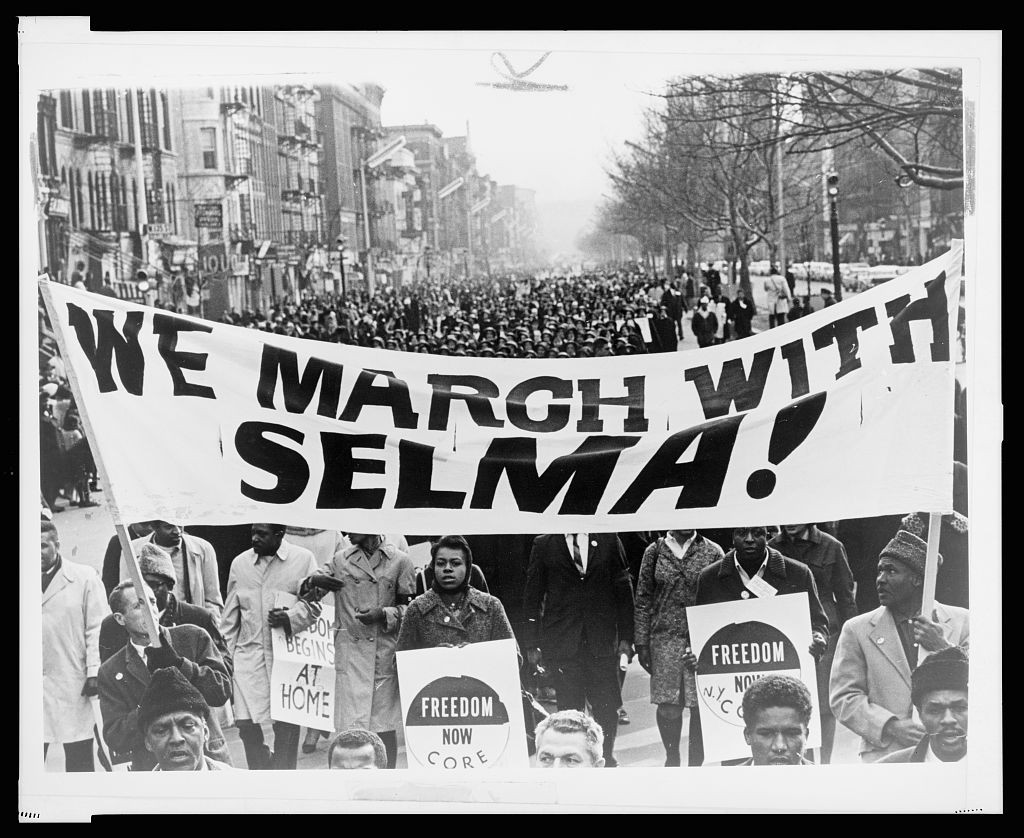
A march of 15,000 in Harlem in solidarity with the Selma voting rights struggle. World Telegram & Sun photo by Stanley Wolfson. Library of Congress.

By Emilye Crosby

On this 50th anniversary year of the Selma-to-Montgomery March and the Voting Rights Act it helped inspire, national attention is centered on the iconic images of “Bloody Sunday,” the words of Dr. Martin Luther King Jr., the interracial marchers, and President Lyndon Johnson signing the Voting Rights Act.

This version of history, emphasizing a top-down narrative and isolated events, reinforces the master narrative that civil rights activists describe as “Rosa sat down, Martin stood up, and the white folks came south to save the day.”

Today, issues of racial equity and voting rights are front and center in the lives of young people. There is much they can learn from an accurate telling of the Selma (Dallas County) voting rights campaign and the larger Civil Rights Movement. We owe it to students on this anniversary to share the history that can help equip them to carry on the struggle today. Continue Reading 15 Points.

Filed Under: News

Freedom Summer and Ferguson, MO: A Special Presentation

December 21, 2014 by Deborah Menkart

On December 5, 2014, New American NYC, in collaboration with the Schomburg Center for Research in Black Culture, held a special event on Freedom Summer and Ferguson, MO. The announcement explained:

Today, fifty years later, with the Voting Rights Act under siege, daily reports of police brutality and racial inequality seen in all realms of American life, we take a look back at the struggles for civil rights and social justice and look at the barriers that still endure.

They began by showing clips of the film Freedom Summer side-by-side with videos from Ferguson, MO.

This was followed by a conversation with Stanley Nelson, film director; Khalil Muhammad, director of the Schomburg Center for Research in Black Culture; Dorie Ladner, SNCC veteran from Hattiesburg,Miss.; and Arlie Schardt, former TIME correspondent.

Here is a short clip of Ladner describing her response to the long trajectory of oppression.

Here is the full program, including the clips from the film Freedom Summer and the scenes from Ferguson.

The photos are by Sade Joseph and the video clips by Tatiana McCabe, Gregory Maher, and Mike Pagano. The photos and videos clips were made available by New America NYC.

Filed Under: News Tagged With: Freedom Summer

Charles McDew: “Why The Others Died”

October 6, 2014 by Julian Hipkins

Charles McDew

The only thing that will make our lives or our deaths meaningful is that we tell the story of why we did what we did and why the others died.

Charles McDew describes the terror of imprisonment and threats to the lives of Civil Rights Movement activists and others during the freedom struggle in a Moth Radio Hour story, “Why The Others Died” (9/30/2014).

In the conclusion to his chilling and tragic story, he notes, “It gave me to understand that it is not a struggle of black people or white people dominating black people; it is a struggle of people without power being exploited, run over, and destroyed.”

Background on Charles McDew

Charles McDew led his first demonstration in the eighth grade, to protest violations of the religious freedom of Amish students in his hometown of Massillon, Ohio.

Charles McDew 2/17/1962.

McDew’s career as an activist expanded in scope while he was a freshman at South Carolina State College in Orangeburg, SC. Inevitably involved in the newborn sit-in movement, he was elected as student leader by his fellow demonstrators.

McDew attended the founding conference of the Student Nonviolent Coordinating Committee (SNCC) at Shaw in April 1960 while a student at South Carolina State and a member of the Orangeburg Movement for Civil Improvement. He served as the second chairperson of SNCC, from 1961-1963.

1963 SNCC fundraiser at the home of actor and activist Theodore Bikel. (l-r) Ivanhoe Donaldson Chuck McDew, Lorraine Hansberry, Nina Simone, Theodore Bikel, and James Forman.  (c) LHLT private collection. Click for more info.
1963 SNCC fundraiser at the home of actor and activist Theodore Bikel. (l-r) Ivanhoe Donaldson, Chuck McDew, Lorraine Hansberry, Nina Simone, Theodore Bikel, and James Forman. (c) Lorraine Hansberry Literary Trust (LHLT) private collection. Click for more info.

McDew has been active in organizations for social and political change, working as a teacher and as a labor organizer, managing anti-poverty programs in Washington, D.C., serving as community organizer and catalyst for change in Boston and San Francisco, as well as other communities.

He has appeared on countless radio and television programs as a speaker against racism. McDew recently retired from Metropolitan State University, Minneapolis, MN, where he taught classes on the history of the civil rights movement, African-American history, and in social and cultural awareness. [Bio from SNCC 50th Anniversary website.]

mothlogoListen to and share Chuck McDew’s story here.

Filed Under: Mississippi, News

Turn-of-the-Century Mississippi Social Studies Teachers Workshop

September 26, 2014 by Deborah Menkart

Mississippi teachers are invited to attend a full day of presentations and workshops on “Turn-of-the-Century Mississippi” on November 7, 2014 sponsored by the Mississippi Department of Archives and History (MDAH). The conference announcement explains that,

The coming of the twentieth century saw great changes throughout the state—social, economic, and industrial. Mississippi’s constitution was rewritten and adopted in 1890 to codify the privileges of white men and institutionalize the impediments to women and African American citizens. The United States and Mississippi were drawn into a world war. Natural disaster ravaged the fertile Delta counties. And a new, native art form was born in the blues.

People get around in boats at the railroad station in Cary, Mississippi, on May 1, 1927, ten days after the flood. Courtesy MDAH.
Cary, Mississippi, May 1, 1927, ten days after the flood. Courtesy MDAH.

The sessions include:

  • Political analyst Jere Nash, “The 1890 Constitution and the Rise of Jim Crow Mississippi”
  • Mississippi Armed Forces Museum director Chad Daniels, “Mississippi in WWI”
  • University of Southern Mississippi associate professor Pamela Tyler, “Woman Suffrage in Mississippi”
  • MDAH outreach programs coordinator Claire Gwaltney, “1927 Mississippi Flood Lesson”
  • Mississippi Arts Commission arts education director Charlotte Smelser, “Blues in Mississippi Curriculum”
  • State Capitol curator Brenda Davis, “Mississippi’s State Capitol”
  • MDAH reference librarian De’Niecechsi Layton, “Genealogy in the Classroom”
  • University of Southern Mississippi associate professor Deanne Nuwer, “Watering Places along the Mississippi Gulf Coast: The Roaring 1920s”

The event will be held at the Old Capitol Museum in Jackson.

The workshop is sponsored by Mississippi Department of Archives and History in conjunction with the Mississippi College School of Continuing Education, Mississippi Department of Education, and Mississippi Historical Society.

Filed Under: Mississippi, News

  • « Previous Page
  • 1
  • 2
  • 3
  • 4
  • …
  • 6
  • Next Page »
A RESOURCE GUIDE FOR CLASSROOMS AND COMMUNITIES

Putting the Movement Back into Civil Rights Teaching

Learn more

Copyright © 2026 · Minimum Pro on Genesis Framework · WordPress · Log in