Civil Rights Teaching

test widget

  • Home
  • News

Educators: Please Complete One Person, One Vote Website Survey

June 27, 2015 by Deborah Menkart

Teaching for Change is honored to be a partnering institution with the One Person, One Vote: the Legacy of SNCC and the Fight for Voting Rights website. The website will expand next year and your input is crucial to guide that process. Please take a few minutes to respond to the survey, as described in the note below from the SNCC Legacy Project and Duke University.

One-Person,-One-Vote_-The-Legacy-of-SNCC-and...-2015-06-26-22-34-49

On March 4, the SNCC Legacy Project and Duke University launched a new documentary website, One Person, One Vote: the Legacy of SNCC and the Fight for Voting Rights. The site tells the story of the Student Nonviolent Coordinating Committee’s (SNCC) commitment to organizing local people in the Deep South around the right to vote. One Person, One Vote weaves together stories with primary source documents, highlighting who SNCC was, what they did, why they did it … and the relevance of SNCC’s organizing to today’s continuing struggles.

The SNCC Legacy Project and Duke University are now planning to expand the site into a larger SNCC Digital Gateway. We’d like your feedback on a short survey to help ensure that this site is an engaging tool that teachers can use to bring SNCC’s grassroots organizing and bottom-up history into the classroom.

We know how much we all love surveys (even short ones), so we’re offering a prize. The winners will receive one of two autographed books: This Nonviolent Stuff’ll Get You Killed: How Guns Made the Civil Rights Movement Possible (personal stories and historical context regarding self-defense in the Southern Movement, written by Charles Cobb, a journalist and veteran SNCC staffer) or Hands on the Freedom Plow: Personal Accounts of Women in SNCC (an anthology of stories written or told by 52 SNCC women about their work in the Southern movement, collected and edited by 6 SNCC women).


this-nonviolent-stuff  hands-on-plow

Please help us by going to the One Person, One Vote website, reviewing it, and giving us your feedback via this survey:

https://duke.qualtrics.com/SE/?SID=SV_7UtnhmPlYsoE2Fv

By leaving your name and e-mail address, you will be entered into our raffle. This survey should take 10 to 15 minutes to complete. Your responses will help guide the partnership of the SNCC Legacy Project and Duke University, over the next three years, as it tells SNCC’s story through the SNCC Digital Gateway. We look forward to your response!

Should you have any technical problems with either the website or the survey, please contact Karlyn Forner.

Thanks for your participation.

Filed Under: News

High School Students Produce Award-Winning Film on Ella Baker

June 19, 2015 by Deborah Menkart

b4s_baker011909_53331a_8col-300x300“The most powerful person in the struggle for civil rights in of the 1960s was Miss Ella Baker, not Martin Luther King,” said Stokely Carmichael.

Two St. Paul, Minnesota high school students—Siena Leone-Getten and Paying Lor—decided to learn more about this influential woman who remains so hidden in history.

Not only did they research her life history, they also produced a well-researched ten minute documentary on Baker that can be used to raise awareness about her decades of activism and her philosophy.

Leone-Getten and Lor’s film, Ella Baker: A Legacy of Grassroots Leadership, won first place in the senior group documentary category for the 2015 National History Day (NHD) competition. It can now be viewed and shared online.


Watching the film, it is evident that Leone-Getten and Lor did extensive research. They started with books and primary documents at the library and then conducted numerous interviews. Here, in their own words, is a summary of their interviews and production process.

Our first interview was with Julian Bond, a founding member of the Student Nonviolent Coordinating Committee (SNCC) who worked closely with Baker. We also spoke with these SNCC members who worked alongside Baker: Hollis Watkins, Judy Richardson, Dorothy Zellner, Penny Patch, Claire O’Connor, Leslie McLemore, and Connie Curry. We learned about her work with students, her leadership style and how she influenced them as activists. Professor J. Todd Moye, her most recent biographer, explained to us how she organized SNCC and influenced people and organizations with her grassroots leadership. Dr. Shana Redmond, the Ella Baker Visiting Professor at USC, focused on the importance of Baker’s organizing style today. We also spoke with Taylor Branch, who has written extensively about the Civil Rights Movement, and who helped us to understand about the organizational differences that Ms. Baker had with Dr. King. We both have enjoyed creating documentaries. This year, we were able to strengthen our research skills, finding interesting footage, photos and documents. After writing the script, we recorded our voiceover, edited interviews, compiled footage and images, and selected music.

Leone-Getten and Lor’s hard work paid off. They produced an award-winning film that will inspire viewers to learn more about the life and legacy of this remarkable woman.

Filed Under: News Tagged With: Ella Baker, NHD, SNCC

Selma in Kosciusko

April 1, 2015 by Deborah Menkart


“Women can do just as much as men can when it comes to leadership.” This is just one of the comments made by students in Jessica Dickens’ class in Kosciusko, Mississippi.

Dickens, a teacher the Kosciusko School District and Mississippi Civil Rights movement and Labor History teacher fellow, recently introduced the lesson, Stepping into Selma: Voting Rights History and Legacy Today, to her 10th grade class. Dickens stated:

Jessica DickensThe best part of teaching this activity was to see the students buy in to it so much. It was more than just a brief overview of a time in history. With both the film (Selma: The Bridge to the Ballot) and the role play, students were able to step into the shoes of the characters in Selma. With the movement in Selma being started mainly by teenagers their own age, it was made more relevant to them.
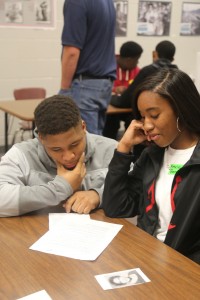
Also, understanding how the government failed to protect the citizens of Selma, we were also able to make connections to events today, such as Ferguson.

Her students shared reflections too.

I enjoyed this lesson because I got a chance to be someone who I have never heard of before. Amelia Boynton was one of the women who led the Civil Rights Movement, specifically in Selma. During the film, I actually got to see some of the brutal beatings that happened in the 60s. In the film, it showed how my character, Amelia Boynton, was shoved by police officers. Some of the things on the film I already knew about, but I also learned about a lot of lesser known people other than Dr. King and Malcolm X. My character in the activity showed me that women can do just as much as men can when it comes to leadership. —Feria M.

I enjoyed this role play activity because I learned details about African Americans who fought and marched for equality and the right to vote. I played Malcolm X in the activity and learned there were many faces to the movement in Selma. To learn the hardships that black people went through inspires me to do the best that I can with the rights I have now. —DeVontaye S.

I enjoyed playing the role of John Lewis. I learned how bad Bloody Sunday really was. I also learned that John Lewis got struck in the head with a billy club and had to be hospitalized. I think it is impressive that he was such a huge part in the movement in Selma and now serves as a U.S. Congressman. The events of the Selma March really opened my eyes to how unjust our country has been in the past. —Blake S.

Filed Under: Mississippi, News

Jesse Harris, Presente!

January 30, 2015 by Deborah Menkart

jesseharrisLongtime civil rights activist and Mississippi Freedom Democratic Party organizer Jesse Harris died of natural causes at the age of 75 on January 28, 2015. Harris was a board member of the Veterans of the Mississippi Civil Rights Movement. We offer here a variety of key sources for learning about the life and achievements of Harris including a news article, video interviews, and a tribute poem.

This foot soldier of the Mississippi Civil Rights Movement will forever be remembered as a steadfast community organizer who worked tirelessly for justice and equality, said Hollis Watkins, chairman of the Veterans of the Mississippi Civil Rights Movement.

“It is our esteemed honor to have been a part of his life, he a part of ours, and his legacy engrained in the civil and human rights we enjoy and continue to fight for today.”

Continue reading this article about Harris by Jerry Mitchell in The Clarion Ledger.


This video clip provides excerpts from interviews with Jesse Harris in 1963 and 1964, courtesy of the Harvey Richards Media Archive.


Jesse Harris got involved in the Civil Rights Movement early in his career. After he heard about the murders of Emmett Till in Money, Mississippi, and Mack Charles Parker in Poplarville, Mississippi, Harris was catapulted into the movement for social justice.

As he recalls, in school, Harris had to write a paper regarding current events taking place—so, he wrote about Mack Charles Parker. His teacher denied accepting the paper because she said it was too controversial to discuss during this tumultuous time in history.

Continue reading this profile of Harris on Freedom50.org


Jesse Harris — A Frontline Soldier in Mississippi

Tribute poem by Tim Jenkins

Who can dare to sound a worthy hymn for Jesse?
Who can capture the unspoken eloquence of his life and service?

The only universally known biographical detail about him was that he was ever
there for every call and every high or low duty needed by his people.

His lanky stature always memorably housed beneath the bib overalls of the
common man, he reassured whoever spoke at a mass meeting that there was at
least one in the audience listening to and believing what was said with his life. His
“Amen” was all that was needed for a speaker to know that the message had been
both received 
and heard, as well as to be acted on.

He spoke without speeching and what he said came from his heart and not just his
tongue. When he sang our songs, it was not from his lips, but from his heart, and
we heard him in ours.

It was through him that the answer came to DuBois’s question, “Will the Souls of
Blackfolk thrive?” It was he who showed the good Doctor the proof and price of
what that answer meant.

It is lovely that he left without being bent by old age as one final lesson to give to
us that “Strong men keep a coming on . . . . Strong men, getting stronger,” just like
Sterling Brown said they would.

We won’t have to pray for Jesse.

It is Jesse, who will have to pray for us to allow us by his example to become men
and women, even stronger!

Your SNCC Buddy,
© Tim Jenkins, For All of US
January 29, 2015

(l-r) Curtis (Hayes) Muhammad, Janes Jones, Jesse Harris, Wazir (Willie B.) Peacock, Charles McLaurin, Jimmie Travis, Samuel Block, MacArthur Cotton, Hollis Watkins, and Charlie Cobb. James Forman kneels in the foreground at  Tougaloo College, 1965. From the Alan Lomax Collection (AFC 2004/004) at the Library of Congress.
(l-r) Curtis (Hayes) Muhammad, James Jones, Jesse Harris, Wazir (Willie B.) Peacock, Charles McLaurin, Jimmie Travis, Samuel Block, MacArthur Cotton, Hollis Watkins, and Charlie Cobb. James Forman kneels in the foreground. Tougaloo College, 1965. From the Alan Lomax Collection, Library of Congress.

Filed Under: Uncategorized

Teaching About Selma

January 26, 2015 by Deborah Menkart

The release of the film Selma in this 50th anniversary year of the Selma-to-Montgomery March and the Voting Rights Act of 1965 has helped generate great interest in these pivotal stories from the Civil Rights Movement.

Schools across the country are taking students to see the film. Commemorative events will be held all year.

selma-15-points-boxToday, racial equity and voting rights are front and center in the lives of young people. There is much they can learn from stepping into the history of the Selma voting rights campaign and the larger Civil Rights Movement. We owe it to students on this anniversary to engage them in the history in a way that allows them to look critically at the world today and equips them to carry on the struggle for justice.

All too often, students think that two people (Martin Luther King and Rosa Parks) were responsible for all the gains made by the Civil Rights Movement. Given this “master narrative,” their response to injustices is often to hope for the next savior to come along.

Check out these interactive lessons and recommended resources that invite students to step into the history and think critically and creatively about the continued fight for justice today.

Filed Under: News

The Selma Voting Rights Struggle: 15 Key Points from Bottom-Up History and Why It Matters Today

January 9, 2015 by Deborah Menkart

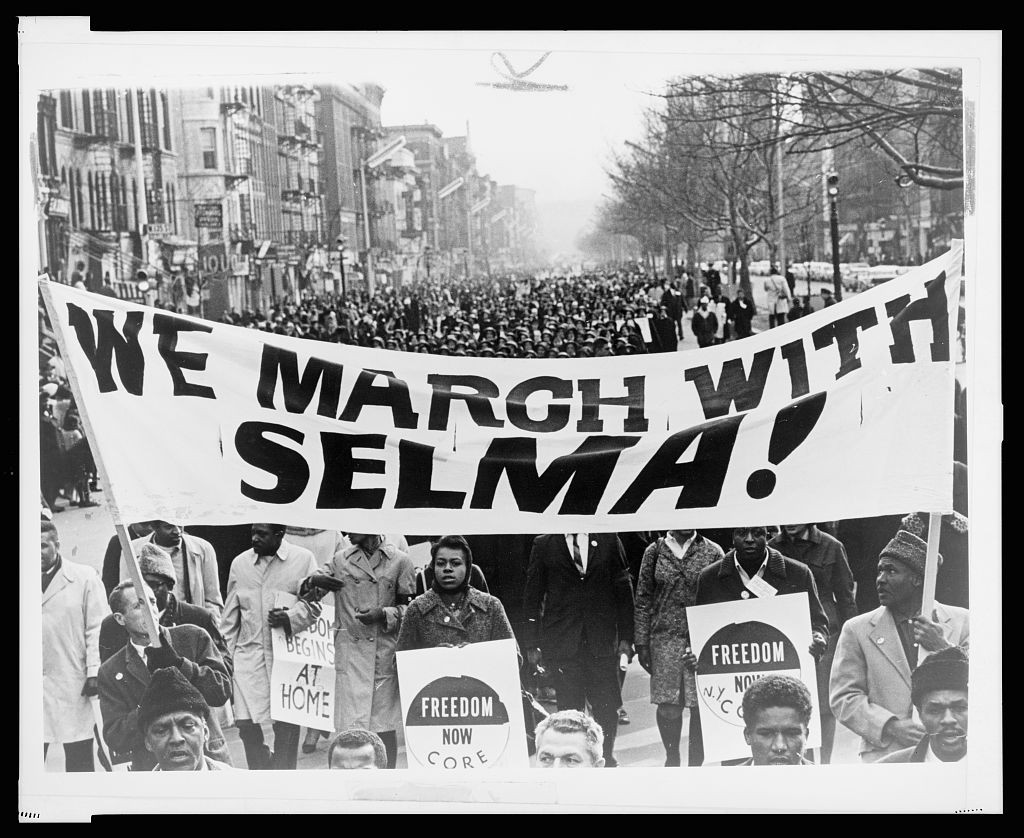
A march of 15,000 in Harlem in solidarity with the Selma voting rights struggle. World Telegram & Sun photo by Stanley Wolfson. Library of Congress.

By Emilye Crosby

On this 50th anniversary year of the Selma-to-Montgomery March and the Voting Rights Act it helped inspire, national attention is centered on the iconic images of “Bloody Sunday,” the words of Dr. Martin Luther King Jr., the interracial marchers, and President Lyndon Johnson signing the Voting Rights Act.

This version of history, emphasizing a top-down narrative and isolated events, reinforces the master narrative that civil rights activists describe as “Rosa sat down, Martin stood up, and the white folks came south to save the day.”

Today, issues of racial equity and voting rights are front and center in the lives of young people. There is much they can learn from an accurate telling of the Selma (Dallas County) voting rights campaign and the larger Civil Rights Movement. We owe it to students on this anniversary to share the history that can help equip them to carry on the struggle today. Continue Reading 15 Points.

Filed Under: News

  • « Previous Page
  • 1
  • 2
  • 3
  • 4
  • …
  • 8
  • Next Page »
A RESOURCE GUIDE FOR CLASSROOMS AND COMMUNITIES

Putting the Movement Back into Civil Rights Teaching

Learn more

Copyright © 2026 · Minimum Pro on Genesis Framework · WordPress · Log in